35) Infinitesimal sl(2)-symmetries on the equivariant skein lasagna module
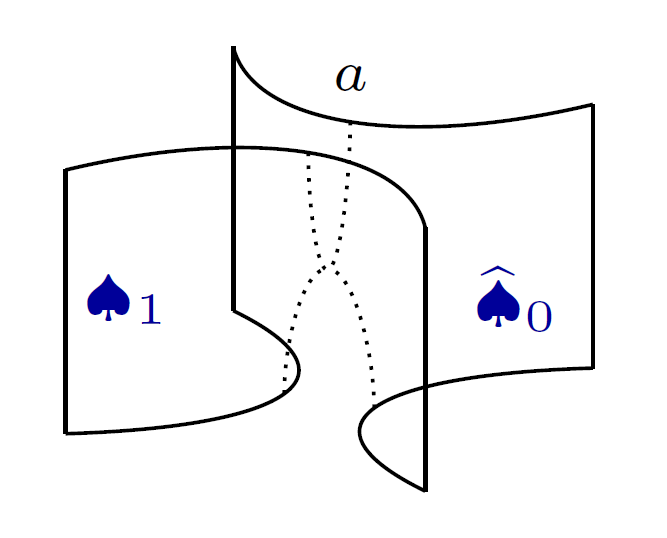
We construct an sl(2)-action on the equivariant skein lasagna module.
With You Qi, Louis-Hadrien Robert, Joshua Sussan, and Emmanuel Wagner.
Universität Hamburg
Fachbereich Mathematik
Bundesstraße 55, 20146 Hamburg, Germany
paul.wedrich@uni-hamburg.de
+49 40 2395-25181
https://orcid.org/0000-0002-2517-7924

 © UHH, RRZ/MCC, Mentz
I am a professor (W2) at the Department of Mathematics at the University of Hamburg, a member of the management committee of the Collaborative Research Center Higher Structures, moduli spaces and integrability, a PI in the Cluster of Excellence Quantum Universe, and spokesperson for the Mathematisches Seminar der Universität Hamburg.
I am the departmental coordinator for the Erasmus+ programme and an equal opportunity representative at the department.
My CV.
MPIM and University of Bonn
06/2020-08/2021
Mathematical Sciences Research Institute
02/2020-05/2020
MPIM and University of Bonn
10/2019-01/2020
The Australian National University
10/2017-09/2019
Imperial College London
10/2015-09/2017
University of Cambridge
10/2015, Advisor: Jake Rasmussen
University of Cambridge
06/2012
Universität Wien
07/2011
Our research seminar on Quantum Topology and Categorification (QTcat) is run jointly with David Reutter's Emmy Noether Research Group Topological quantum field theory beyond three dimensions.
My research interests are in low-dimensional topology and representation theory. In particular, I am interested in topological quantum field theories (TQFTs) and higher structures related to link homology theories, and the exploration of their deep connections to (higher) representation theory and mathematical physics. I also enjoy applying topological and combinatorial tools to solve problems in representation theory.
An outline of main aspects of my research programme appears in this recorded talk at the Simons Foundation in March 2025.
My research papers are available on the mathematics arXiv. They are also listed by Google Scholar and ORCiD. Preprints and published or accepted articles appear in order of first arXiv posting on the following list.
We construct an sl(2)-action on the equivariant skein lasagna module.
With You Qi, Louis-Hadrien Robert, Joshua Sussan, and Emmanuel Wagner.
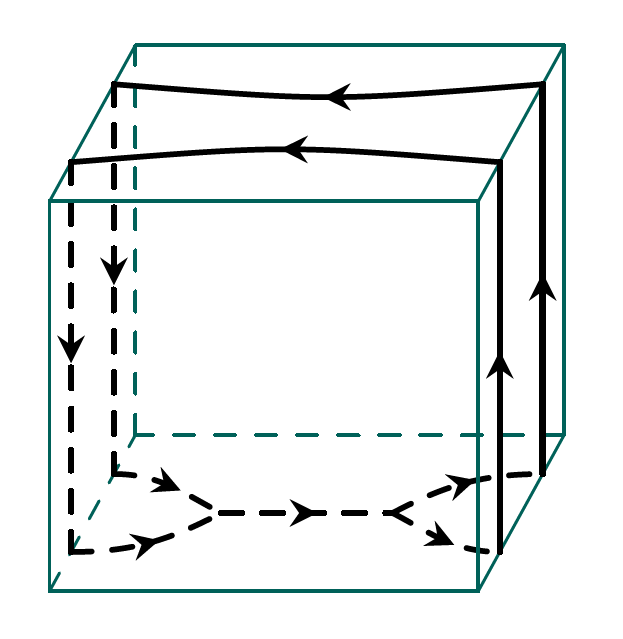
In this paper we describe a general framework for constructing examples of locally linear semistrict monoidal 2-categories covering many examples appearing in link homology theory. The main input datum is a closed foam evaluation formula. As examples, we rigorously construct semistrict monoidal 2-categories based on gl(N)-foams, which underlie the general linear link homology theories, and further examples based on Bar-Natan's decorated cobordisms, related to Khovanov homology. These monoidal 2-categories are typically non-semisimple, have duals for all objects, adjoints for all 1-morphisms, and carry a canonical spatial duality structure expressing oriented 3-dimensional pivotality and sphericality.
With Leon J. Goertz and Laura Marino.
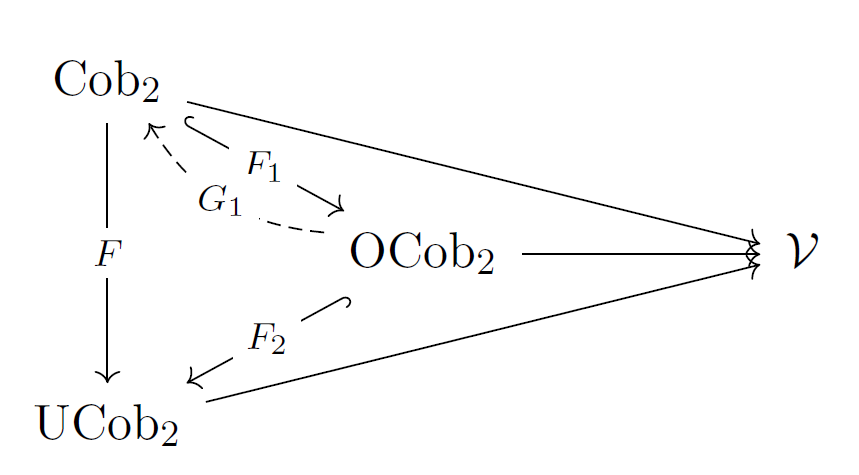
Topological quantum field theories (TQFTs) are symmetric monoidal functors out of cobordism categories. In dimension two, oriented TQFTs are famously classified by commutative Frobenius algebras. In the unoriented setting, the classification requires additional data: an involution and a value assigned to the Möbius strip. In this work, we describe an intermediate framework that classifies 2-dimensional TQFTs for orientable cobordisms, in an appropriate sense. Our motivation arises from skein-theoretic models of surfaces embedded in 3-manifolds and Khovanov homology, where surfaces are often treated as unoriented, even though the associated 2-dimensional TQFTs themselves need not be fully unoriented.
With Leon J. Goertz.

We construct a variant of Khovanov skein lasagna modules, which takes the Khovanov homology in connected sums of S1 x S2 defined by Rozansky and Willis as the input link homology. To carry out the construction, we prove functoriality of Rozansky-Willis's homology for cobordisms in a class of 4-manifolds that we call 4-dimensional relative 1-handlebody complements, by using, as a bypass, an isomorphism proved by Sullivan-Zhang relating the Rozansky-Willis homology and the classical Khovanov skein lasagna module of links on the boundary of D2 x S2. Along the way, we also present new results on diffeomorphism groups, on Gluck twists for Khovanov skein lasagna modules, and on the functoriality of gl(2) foams.
With Qiuyu Ren, Ian Sullivan, Michael Willis, and Melissa Zhang.
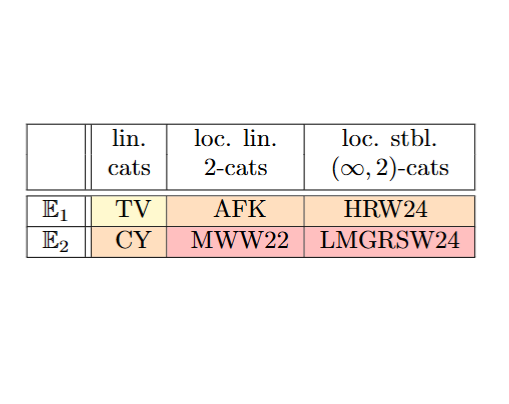
This survey reviews recent advances connecting link homology theories to invariants of smooth 4-manifolds and extended topological quantum field theories. Starting from joint work with Morrison and Walker, I explain how functorial link homologies that satisfy additional invariance conditions become diagram-independent, give rise to braided monoidal 2-categories, extend naturally to links in the 3-sphere, and globalize to skein modules for 4-manifolds. Later developments show that these skein lasagna modules furnish invariants of embedded and immersed surfaces and admit computation via handle decompositions. I then survey structural properties, explicit computations, and applications to exotic phenomena in 4-manifold topology, and place link homology and skein lasagna modules within the framework of extended topological quantum field theories
Contributed to the proceedings of the 2025 International Congress of Basic Science (ICBS) (Jul 13th to 25th, 2025).
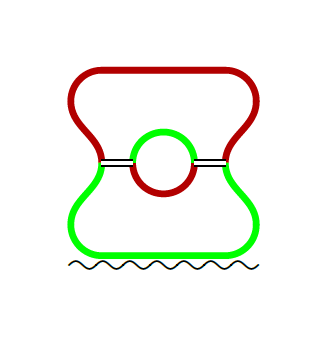
This expository note outlines why it is sometimes useful to consider the bigraded type A link homology theories as associated with the Lie algebras gl(N) instead of sl(N).
Proceedings of the International Conference on Knots, Quivers and Beyond (2025) 105--121..
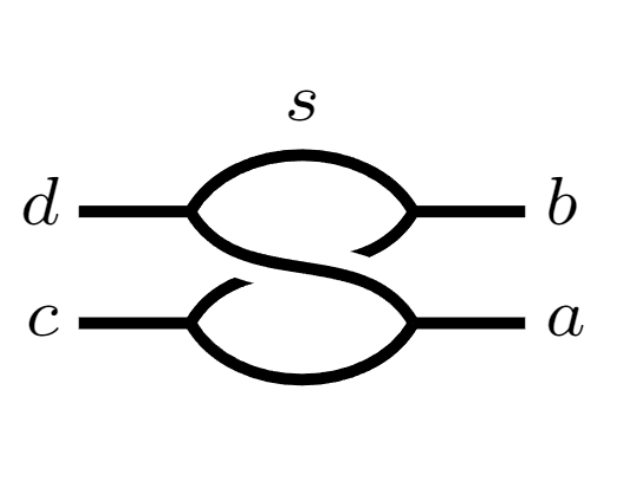
We define the concept of an An-schober as a categorification of classification data for perverse sheaves on Sym^(n+1)(C) due to Kapranov-Schechtman. We show that any An-schober gives rise to a categorical action of the Artin braid group Br_(n+1) and demonstrate how this recovers familiar examples of such actions arising from Seidel-Thomas An-configurations of spherical objects in categorical Picard-Lefschetz theory and Rickard complexes in link homology theory. As a key example, we use singular Soergel bimodules to construct a factorizing family of An-schobers which we refer to as Soergel schobers. We expect such families to give rise to a categorical analog of a graded bialgebra valued in a suitably defined freely generated braided monoidal (infinity,2)-category.
With Tobias Dyckerhoff.
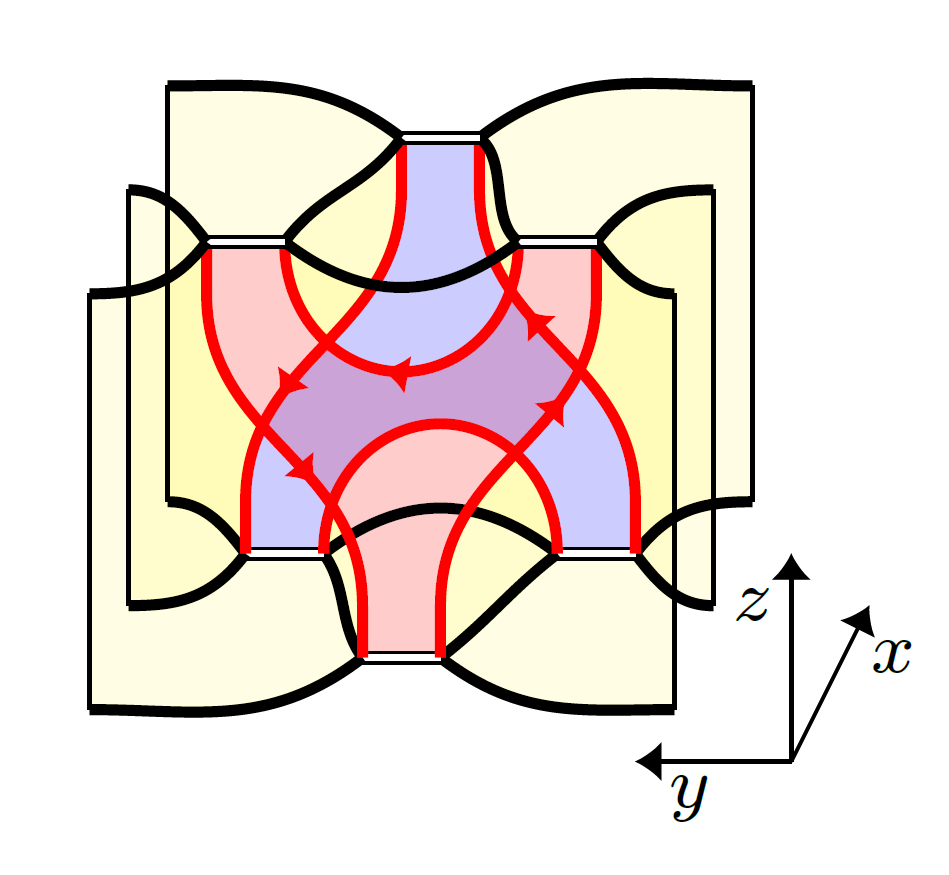
We consider categories of Soergel bimodules for the symmetric groups S_n in their gl(n)-realizations for all n and assemble them into a locally linear monoidal bicategory. Chain complexes of Soergel bimodules likewise form a locally dg-monoidal bicategory which can be equipped with the structure of a braiding, whose data includes the Rouquier complexes of shuffle braids. The braiding, together with a uniqueness result, was established in an infinity-categorical setting in recent work with Yu Leon Liu, Aaron Mazel-Gee and David Reutter. In the present article, we construct this braiding explicitly and describe its requisite coherent naturality structure in a concrete dg-model for the morphism categories. To this end, we first assemble the Elias-Khovanov-Williamson diagrammatic Hecke categories as well as categories of chain complexes thereover into locally linear semistrict monoidal 2-categories. Along the way, we prove strictness results for certain standard categorical constructions, which may be of independent interest. In a second step, we provide explicit (higher) homotopies for the naturality of the braiding with respect to generating morphisms of the Elias-Khovanov-Williamson diagrammatic calculus. Rather surprisingly, we observe hereby that higher homotopies appear already for height move relations of generating morphisms. Finally, we extend the homotopy-coherent naturality data for the braiding to all chain complexes using cohomology-vanishing arguments.
With Catharina Stroppel.
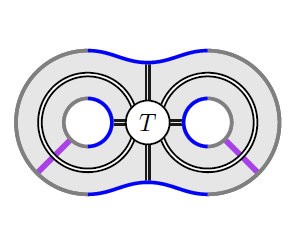
To every compact oriented surface that is composed entirely out of 2-dimensional 0- and 1-handles, we construct a dg category using structures arising in Khovanov homology. These dg categories form part of the 2-dimensional layer (a.k.a. modular functor) of a categorified version of the sl(2) Turaev-Viro topological field theory. As a byproduct, we obtain a unified perspective on several hitherto disparate constructions in categorified quantum topology, including the Rozansky-Willis invariants, Asaeda-Przytycki--Sikora homologies for links in thickened surfaces, categorified Jones-Wenzl projectors and associated spin networks, and dg horizontal traces.
With Matthew Hogancamp and David Rose.
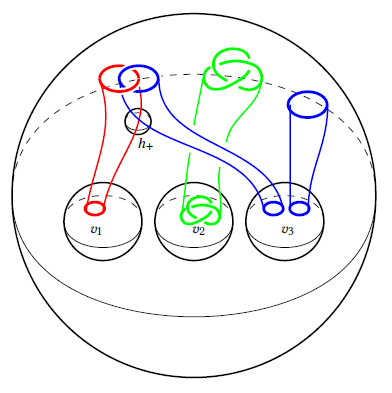
We construct analogs of Khovanov-Jacobsson classes and the Rasmussen invariant for links in the boundary of any smooth oriented 4-manifold. The main tools are skein lasagna modules based on equivariant and deformed versions of gl(N) link homology, for which we prove non-vanishing and decomposition results.
With Scott Morrison and Kevin Walker.
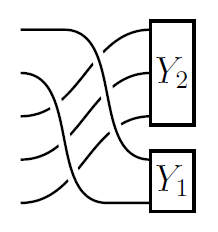
The Hecke algebras for all symmetric groups taken together form a braided monoidal category that controls all quantum link invariants of type A and, by extension, the standard canon of topological quantum field theories in dimension 3 and 4. Here we provide the first categorification of this Hecke braided monoidal category, which takes the form of an E2-monoidal (infinity,2)-category whose hom-(infinity,1)-categories are k-linear, stable, idempotent-complete, and equipped with Z-actions. This categorification is designed to control homotopy-coherent link homology theories and to-be-constructed topological quantum field theories in dimension 4 and 5. Our construction is based on chain complexes of Soergel bimodules, with monoidal structure given by parabolic induction and braiding implemented by Rouquier complexes, all modelled homotopy-coherently. This is part of a framework which allows to transfer the toolkit of the categorification literature into the realm of infinity-categories and higher algebra. Along the way, we develop families of factorization systems for (infinity,n)-categories, enriched infinity-categories, and infinity-operads, which may be of independent interest. As a service aimed at readers less familiar with homotopy-coherent mathematics, we include a brief introduction to the necessary infinity-categorical technology in the form of an appendix.
With Yu Leon Liu, Aaron Mazel-Gee, David Reutter, and Catharina Stroppel.
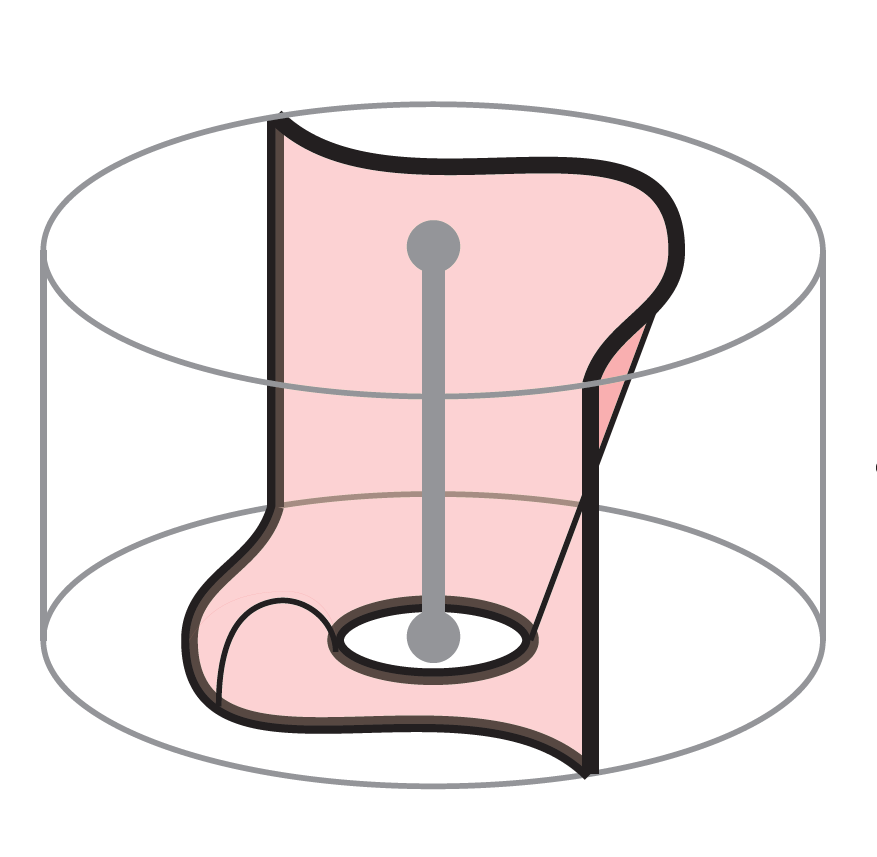
We construct a Kirby color in the setting of Khovanov homology: an ind-object of the annular Bar-Natan category that is equipped with a natural handle slide isomorphism. Using functoriality and cabling properties of Khovanov homology, we define a Kirby-colored Khovanov homology that is invariant under the handle slide Kirby move, up to isomorphism. Via the Manolescu--Neithalath 2-handle formula, Kirby-colored Khovanov homology agrees with the gl(2) skein lasagna module, hence is an invariant of 4-dimensional 2-handlebodies.
With Matthew Hogancamp and David Rose.
Journal of the European Mathematical Society (2025), published online first
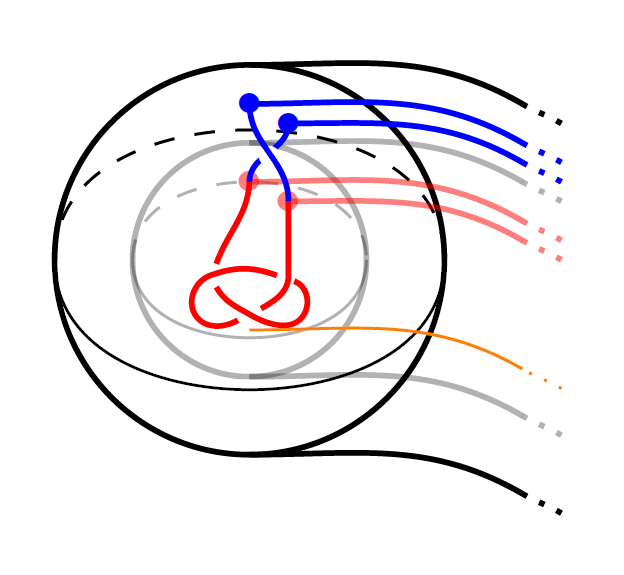
The skein lasagna module is an extension of Khovanov-Rozansky homology to the setting of a four-manifold and a link in its boundary. This invariant plays the role of the Hilbert space of an associated fully extended (4+epsilon)-dimensional TQFT. We give a general procedure for expressing the skein lasagna module in terms of a handle decomposition for the four-manifold. We use this to calculate a few examples, and show that the skein lasagna module can sometimes be locally infinite dimensional.
With Ciprian Manolescu and Kevin Walker.
Advances in Mathematics 425 (2023) Paper No. 109071
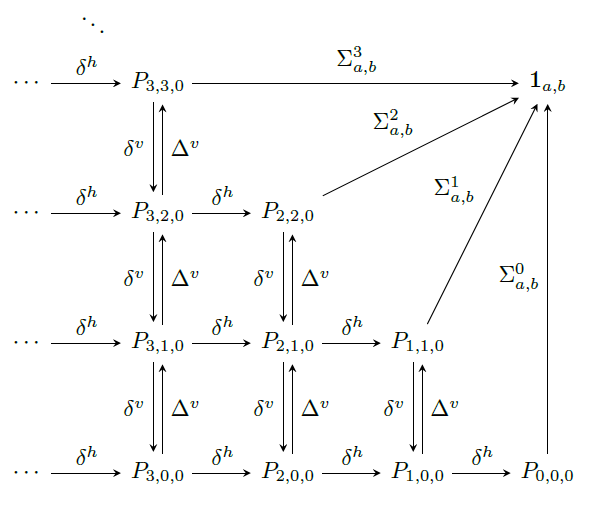
We introduce a multi-parameter deformation of the triply-graded Khovanov-Rozansky homology of links colored by one-column Young diagrams, generalizing the "y-ified" link homology of Gorsky-Hogancamp and work of Cautis--Lauda--Sussan. For each link component, the natural set of deformation parameters corresponds to interpolation coordinates on the Hilbert scheme of the plane. We extend our deformed link homology theory to braids by introducing a monoidal dg 2-category of curved complexes of type A singular Soergel bimodules. Using this framework, we promote to the curved setting the categorical colored skein relation from arXiv:2107.08117 and also the notion of splitting map for the colored full twists on two strands. As applications, we compute the invariants of colored Hopf links in terms of ideals generated by Haiman determinants and use these results to establish general link splitting properties for our deformed, colored, triply-graded link homology. Informed by this, we formulate several conjectures that have implications for the relation between (colored) Khovanov--Rozansky homology and Hilbert schemes.
With Matthew Hogancamp and David Rose.
Proceedings of the London Mathematical Society 129-3 (2024) e12620
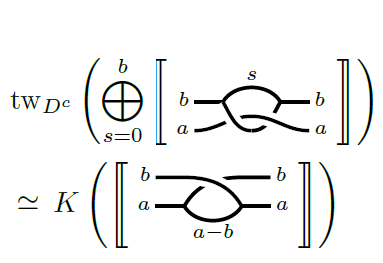
We study the skein relation that governs the HOMFLYPT invariant of links colored by one-column Young diagrams. Our main result is a categorification of this colored skein relation. This takes the form of a homotopy equivalence between two one-sided twisted complexes constructed from Rickard complexes of singular Soergel bimodules associated to braided webs. Along the way, we prove a conjecture of Beliakova-Habiro relating the colored 2-strand full twist complex with the categorical ribbon element for quantum sl(2).
With Matthew Hogancamp and David Rose.
Selecta Mathematica 32, 35 (2026)
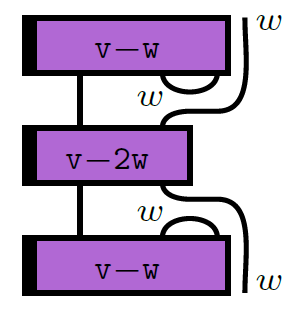
Using the non-semisimple Temperley-Lieb calculus, we study the additive and monoidal structure of the category of tilting modules for SL2 in the mixed case. This simultaneously generalizes the semisimple situation, the case of the complex quantum group at a root of unity, and the algebraic group case in positive characteristic. We describe character formulas and give a presentation of the category of tilting modules as an additive category via a quiver with relations. Turning to the monoidal structure, we describe fusion rules and obtain an explicit recursive description of the appropriate analog of Jones-Wenzl projectors. We also discuss certain theta values, the tensor ideals, mixed Verlinde quotients and the non-degeneracy of the braiding.
With Louise Sutton, Daniel Tubbenhauer, and Jieru Zhu.
Selecta Mathematica 29 (2023) Paper No. 39.
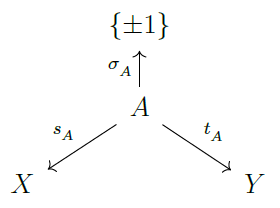
The Blanchet link homology theory is an oriented model of Khovanov homology, functorial over the integers with respect to link cobordisms. We formulate a stable homotopy refinement of the Blanchet theory, based on a comparison of the Blanchet and Khovanov chain complexes associated to link diagrams. The construction of the stable homotopy type relies on the signed Burnside category approach of Sarkar-Scaduto-Stoffregen.
With Vyacheslav Krushkal.
Indiana University Mathematics Journal 72-3 (2023) 731--755.
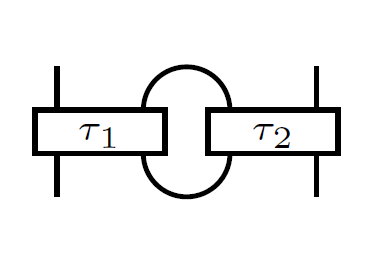
We prove that the generating functions for the one row/column colored HOMFLY-PT invariants of arborescent links are specializations of the generating functions of the motivic Donaldson-Thomas invariants of appropriate quivers that we naturally associate with these links. Our approach extends the previously established tangles-quivers correspondence for rational tangles to algebraic tangles by developing gluing formulas for HOMFLY-PT skein generating functions under Conway's tangle addition. As a consequence, we prove the conjectural links-quivers correspondence of Kucharski–Reineke–Stošić–Sułkowski for all arborescent links.
With Marko Stošić.
Journal of the London Mathematical Society 104-1 (2021) 341-361
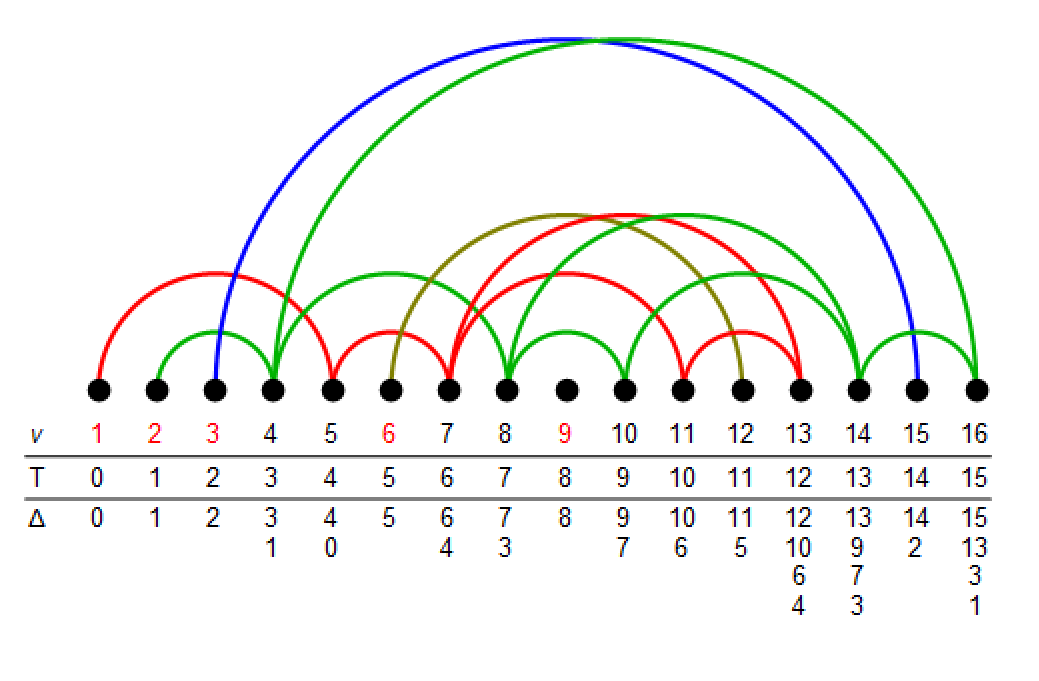
In this note we compute the centers of the categories of tilting modules for G=SL(2) in prime characteristic, of tilting modules for the corresponding quantum group at a complex root of unity, and of projective G_gT-modules when g=1,2.
With Daniel Tubbenhauer.
Glasgow Mathematical Journal 64 (2022) 165-184

The hamiltonian of the N-state superintegrable chiral Potts (SICP) model is written in terms of a coupled algebra defined by N-1 types of Temperley-Lieb generators. This generalises a previous result for N=3 obtained by J. F. Fjelstad and T. Månsson [J. Phys. A 45 (2012) 155208]. A pictorial representation of a related coupled algebra is given for the N=3 case which involves a generalisation of the pictorial representation of the Temperley-Lieb algebra to include a pole around which loops can become entangled. (shortened)
With Remy Adderton and Murray T. Batchelor.
Journal of Physics A: Mathematical and Theoretical 53-36 (2020)
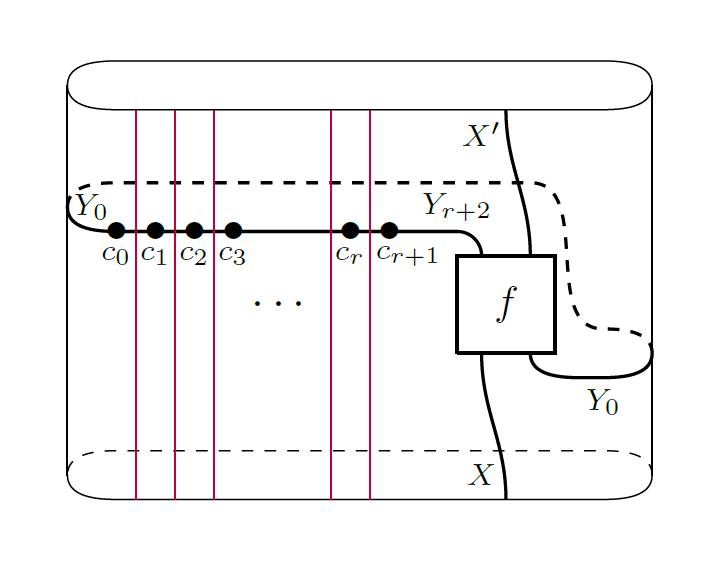
We study two kinds of categorical traces of (monoidal) dg categories, with particular interest in categories of Soergel bimodules. First, we explicitly compute the usual Hochschild homology, or derived vertical trace, of the category of Soergel bimodules in arbitrary types. Secondly, we introduce the notion of derived horizontal trace of a monoidal dg category and compute the derived horizontal trace of Soergel bimodules in type $A$. As an application we obtain a derived annular Khovanov--Rozansky link invariant with an action of full twist insertion, and thus a categorification of the HOMFLY-PT skein module of the solid torus.
With Eugene Gorsky and Matthew Hogancamp.
International Mathematics Research Notices 15 (2022) 11304-11400.
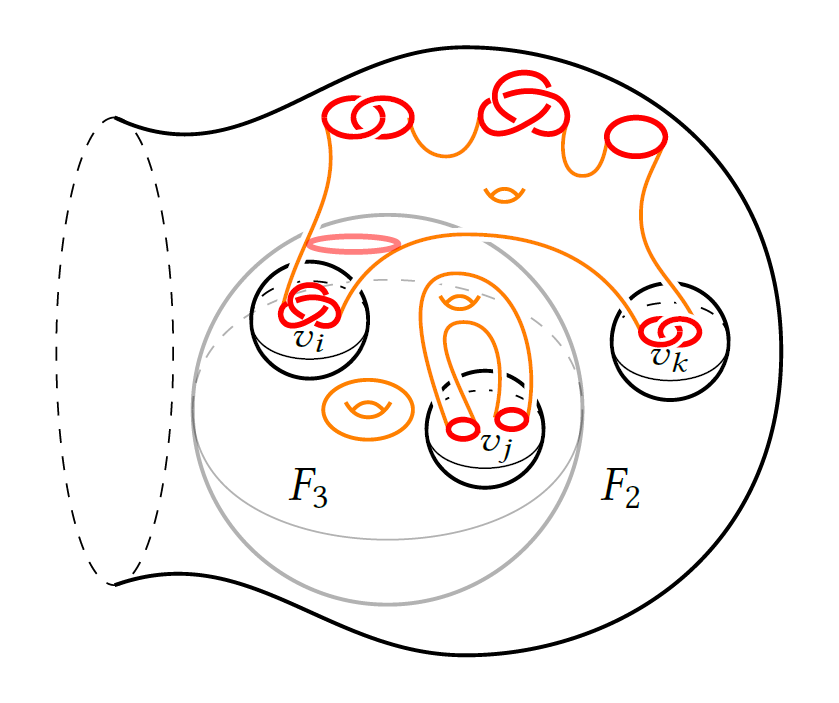
We use Khovanov-Rozansky gl(N) link homology to define invariants of oriented smooth 4-manifolds, as skein modules constructed from certain 4-categories with well-behaved duals. The technical heart of this construction is a proof of the sweep-around property, which makes these link homologies well defined in the 3-sphere.
With Scott Morrison and Kevin Walker.
Geometry & Topology 26-8 (2022) 3367--3420.
Using diagrammatic methods, we define a quiver algebra depending on a prime p and show that it is the algebra underlying the category of tilting modules for SL(2) in characteristic p. Along the way we obtain a presentation for morphisms between p-Jones-Wenzl projectors.
With Daniel Tubbenhauer.
Representation Theory 25 (2021) 440-480
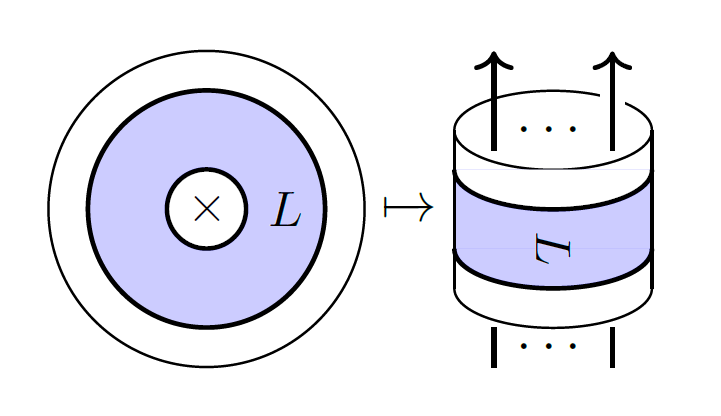
We describe the universal target of annular Khovanov-Rozansky link homology functors as the homotopy category of a free symmetric monoidal category generated by one object and one endomorphism. This categorifies the ring of symmetric functions and admits categorical analogues of plethystic transformations, which we use to characterize the annular invariants of Coxeter braids. Further, we prove the existence of symmetric group actions on the Khovanov-Rozansky invariants of cabled tangles and we introduce spectral sequences that aid in computing the homologies of generalized Hopf links. Finally, we conjecture a characterization of the horizontal traces of Rouquier complexes of Coxeter braids in other types.
With Eugene Gorsky.
Math Z. 303-25 (2023)
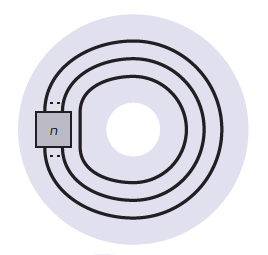
Nous proposons une illustration diagrammatique abordable du concept de catégorification qui s’est développé au cours des vingt dernières années.
A friendly outreach article in French, written mostly by Hoel Queffelec, inspired by our joint work.
La Gazette des mathématiciens 163 (janvier 2020)
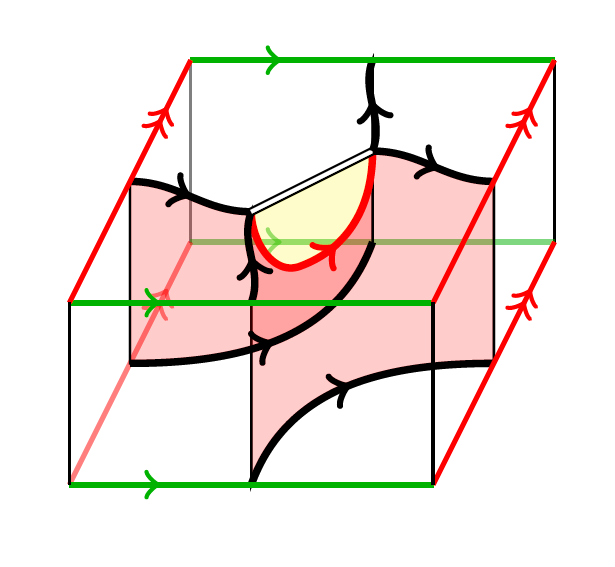
For every oriented surface of finite type, we construct a functorial Khovanov homology for links in a thickening of the surface, which takes values in a categorification of the corresponding gl(2) skein module. The latter is a mild refinement of the Kauffman bracket skein algebra, and its categorification is constructed using a category of gl(2) foams that admits an interesting non-negative grading. We expect that the natural algebra structure on the gl(2) skein module can be categorified by a tensor product that makes the surface link homology functor monoidal. We construct a candidate bifunctor on the target category and conjecture that it extends to a monoidal structure. This would give rise to a canonical basis of the associated gl(2) skein algebra and verify an analogue of a positivity conjecture of Fock–Goncharov and Turston. We provide evidence towards the monoidality conjecture by checking several instances of a categorified Frohman-Gelca formula for the skein algebra of the torus. Finally, we recover a variant of the Asaeda–Przytycki–Sikora surface link homologies and prove that surface embeddings give rise to spectral sequences between them.
With Hoel Queffelec
Quantum Topology 21-1 (2021) 129-209.
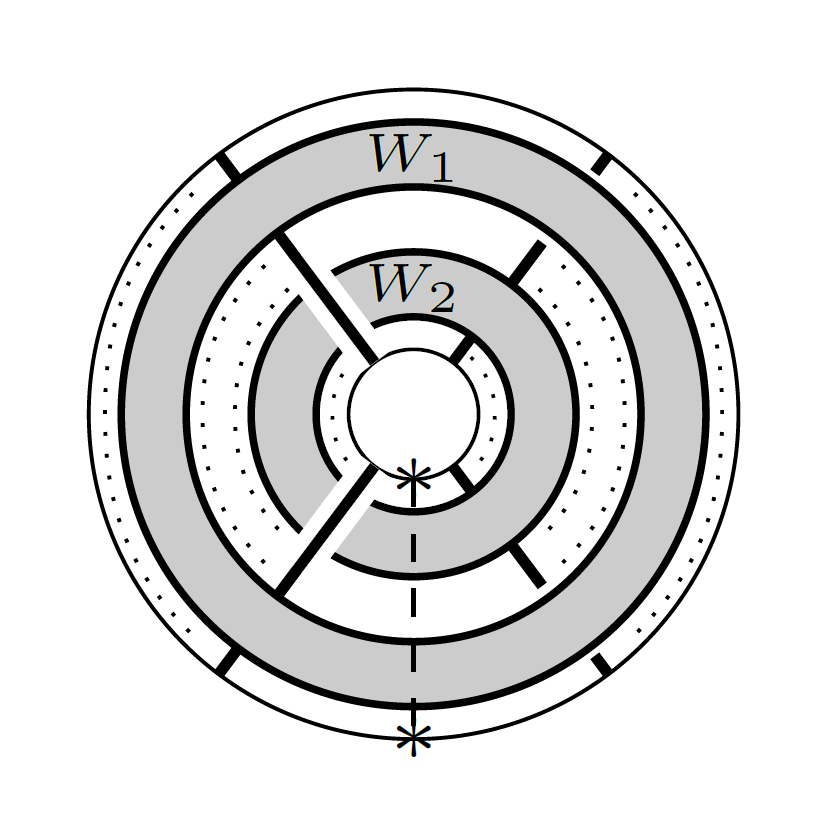
In previous work, we have constructed diagrammatic idempotents in an affine extension of the Temperley–Lieb category, which describe extremal weight projectors for sl(2), and which categorify Chebyshev polynomials of the first kind. In this paper, we generalize the construction of extremal weight projectors to the case of gl(N) for N > 1, with a view towards categorifying the corresponding torus skein algebras via Khovanov–Rozansky link homology. As by-products, we obtain compatible diagrammatic presentations of the representation categories of gl(N) and its Cartan subalgebra, and a categorification of power-sum symmetric polynomials.
With Hoel Queffelec.
Algebraic Combinatorics 7-1 (2024) 187-223.
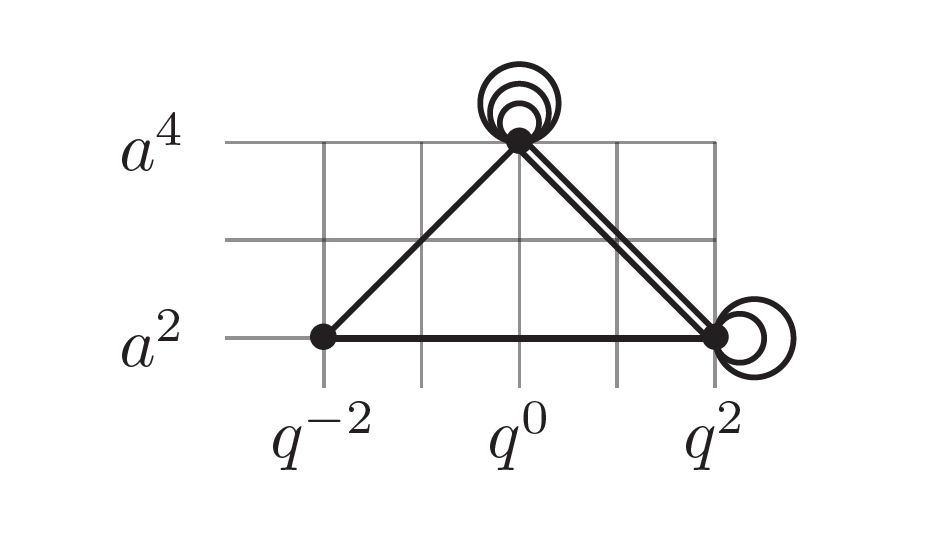
We prove that the generating functions for the colored HOMFLY-PT polynomials of rational links are specializations of the generating functions of the motivic Donaldson-Thomas invariants of appropriate quivers that we naturally associate with these links. This shows that the conjectural links-quivers correspondence of Kucharski–Reineke–Stošić–Sułkowski as well as the LMOV conjecture hold for rational links. Along the way, we extend the links-quivers correspondence to tangles and, thus, explore elements of a skein theory for motivic Donaldson-Thomas invariants.
With Marko Stošić.
International Mathematical Research Notices 6 (2021) 4169-4210.
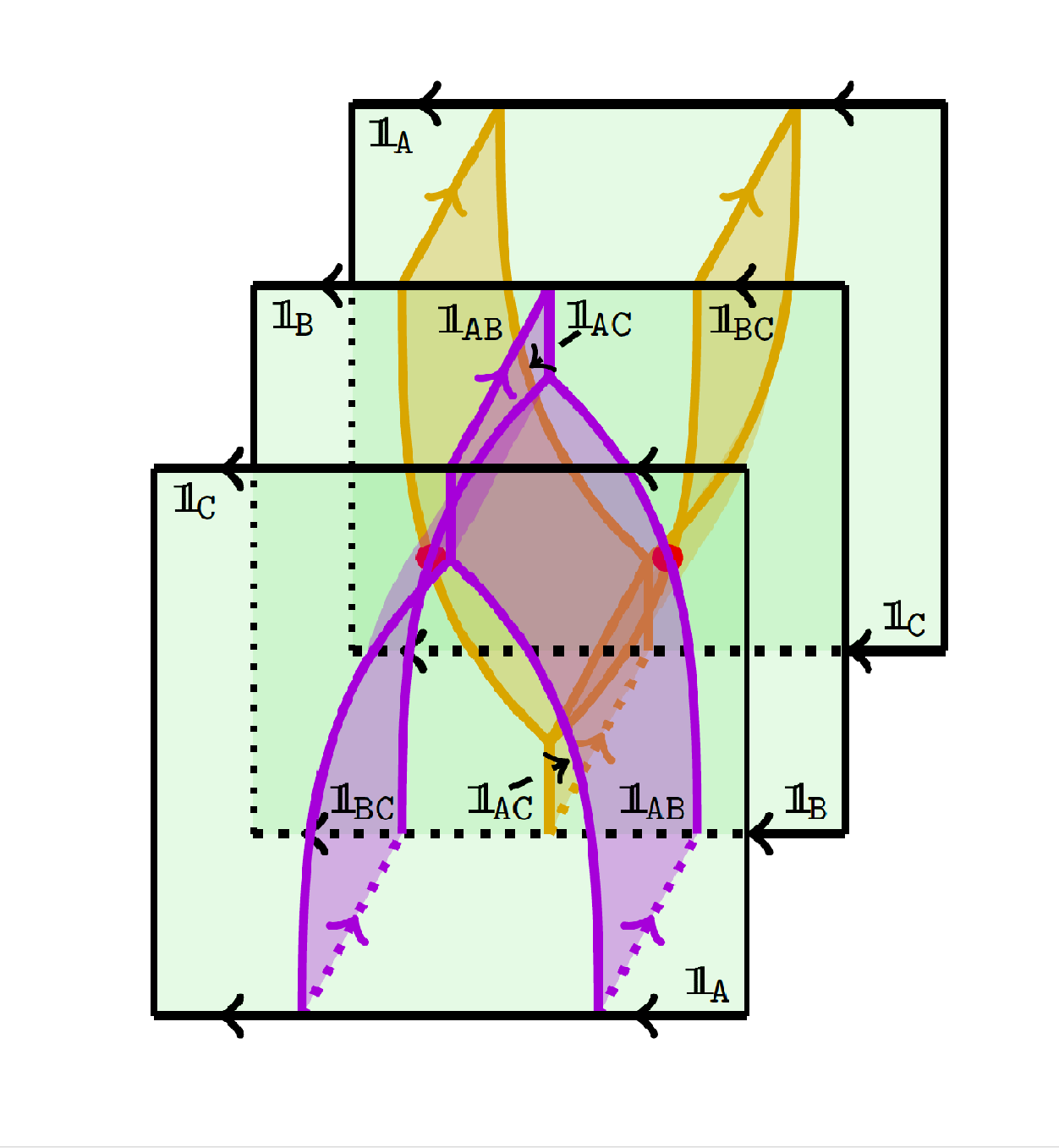
We prove that the bigraded, colored Khovanov–Rozansky type A link and tangle invariants are functorial with respect to link and tangle cobordisms.
With Michael Ehrig and Daniel Tubbenhauer.
Proceedings of the London Mathematical Society 117-5 (2018), 996-1040
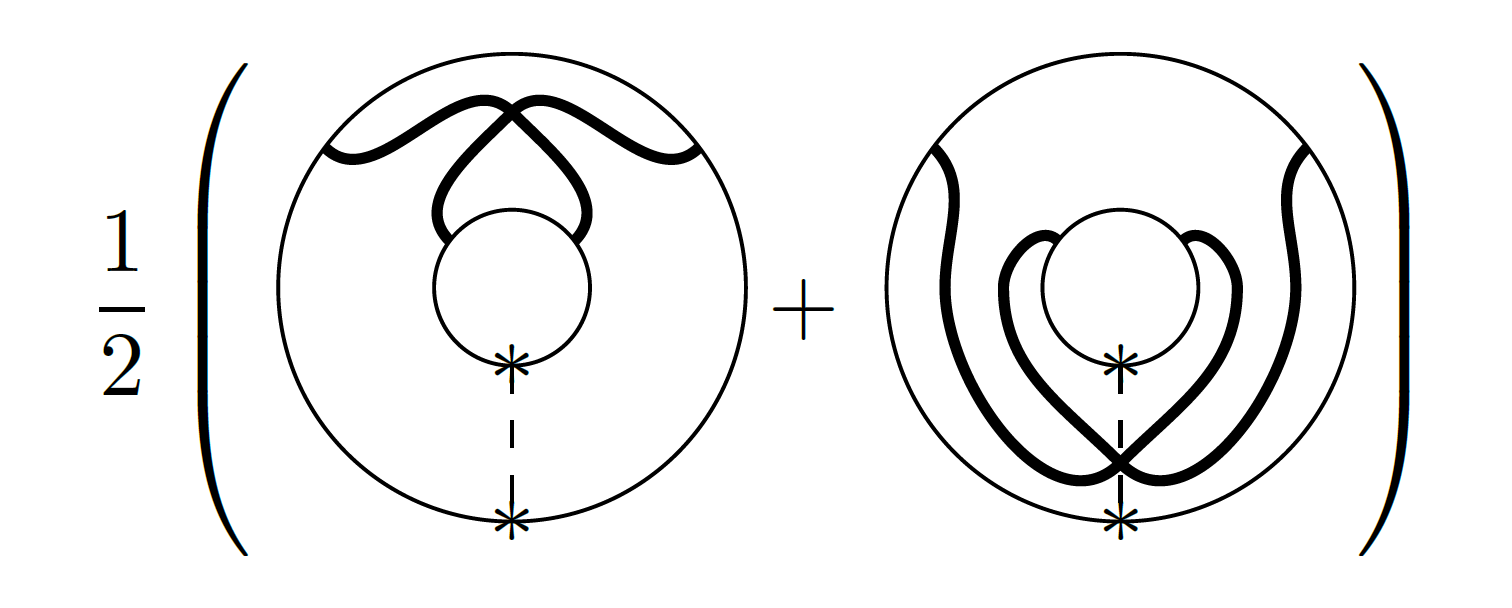
We introduce a quotient of the affine Temperley-Lieb category that encodes all weight preserving linear maps between finite-dimensional sl(2)-representations. We study the diagrammatic idempotents that correspond to projections onto extremal weight spaces and find that they satisfy similar properties as Jones-Wenzl projectors, and that they categorify the Chebyshev polynomials of the first kind. This gives a categorification of the Kauffman bracket skein algebra of the annulus, which is well adapted to the task of categorifying the multiplication on the Kauffman bracket skein module of the torus.
With Hoel Queffelec.
Mathematical Research Letters 25-6 (2018), 1911-1936
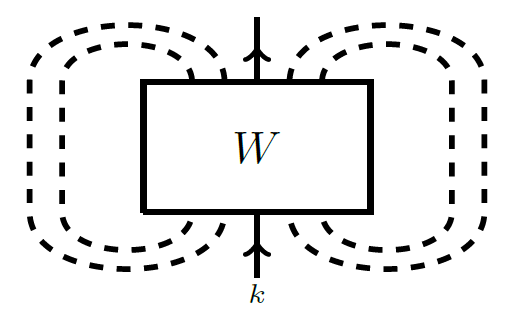
We define reduced colored sl(N) link homologies and use deformation spectral sequences to characterize their dependence on color and rank. We then define reduced colored HOMFLY-PT homologies and prove that they arise as large N limits of sl(N) homologies. Together, these results allow proofs of many aspects of the physically conjectured structure of the family of type A link homologies. In particular, we verify a conjecture of Gorsky, Gukov and Stošić about the growth of colored HOMFLY-PT homologies.
Advances in Mathematics 353 (2019), 471-525
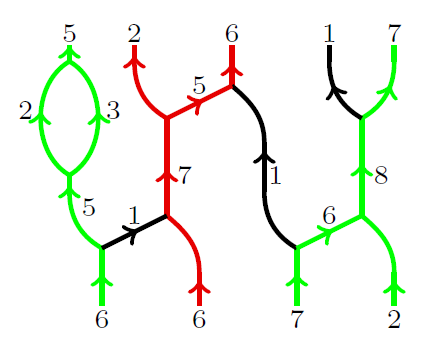
We use super q–Howe duality to provide diagrammatic presentations of an idempotented form of the Hecke algebra and of categories of gl(N)–modules (and, more generally, gl(N|M)–modules) whose objects are tensor generated by exterior and symmetric powers of the vector representations. As an application, we give a representation-theoretic explanation and a diagrammatic version of a known symmetry of colored HOMFLY–PT polynomials.
With Daniel Tubbenhauer and Pedro Vaz.
Algebraic & Geometric Topology 17-6 (2017), 3703-3749
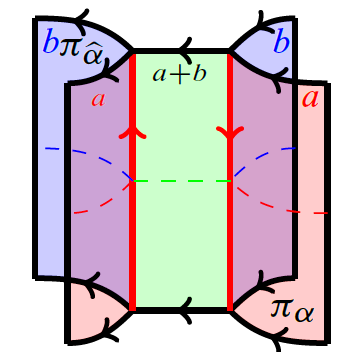
We prove a conjectured decomposition of deformed sl(N) link homology, as well as an extension to the case of colored links, generalizing results of Lee, Gornik, and Wu. To this end, we use foam technology to give a completely combinatorial construction of Wu’s deformed colored sl(N) link homologies. By studying the underlying deformed higher representation-theoretic structures and generalizing the Karoubi envelope approach of Bar-Natan and Morrison, we explicitly compute the deformed invariants in terms of undeformed type A link homologies of lower rank and color.
With David Rose.
Geometry & Topology 20-6 (2016), 3431-3517
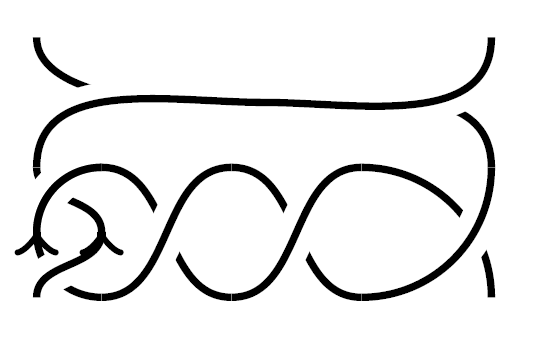
We compute q-holonomic formulas for the HOMFLY polynomials of 2-bridge links colored with one-column (or one-row) Young diagrams.
Journal of Pure and Applied Algebra 223-4 (2019), 1434-1439
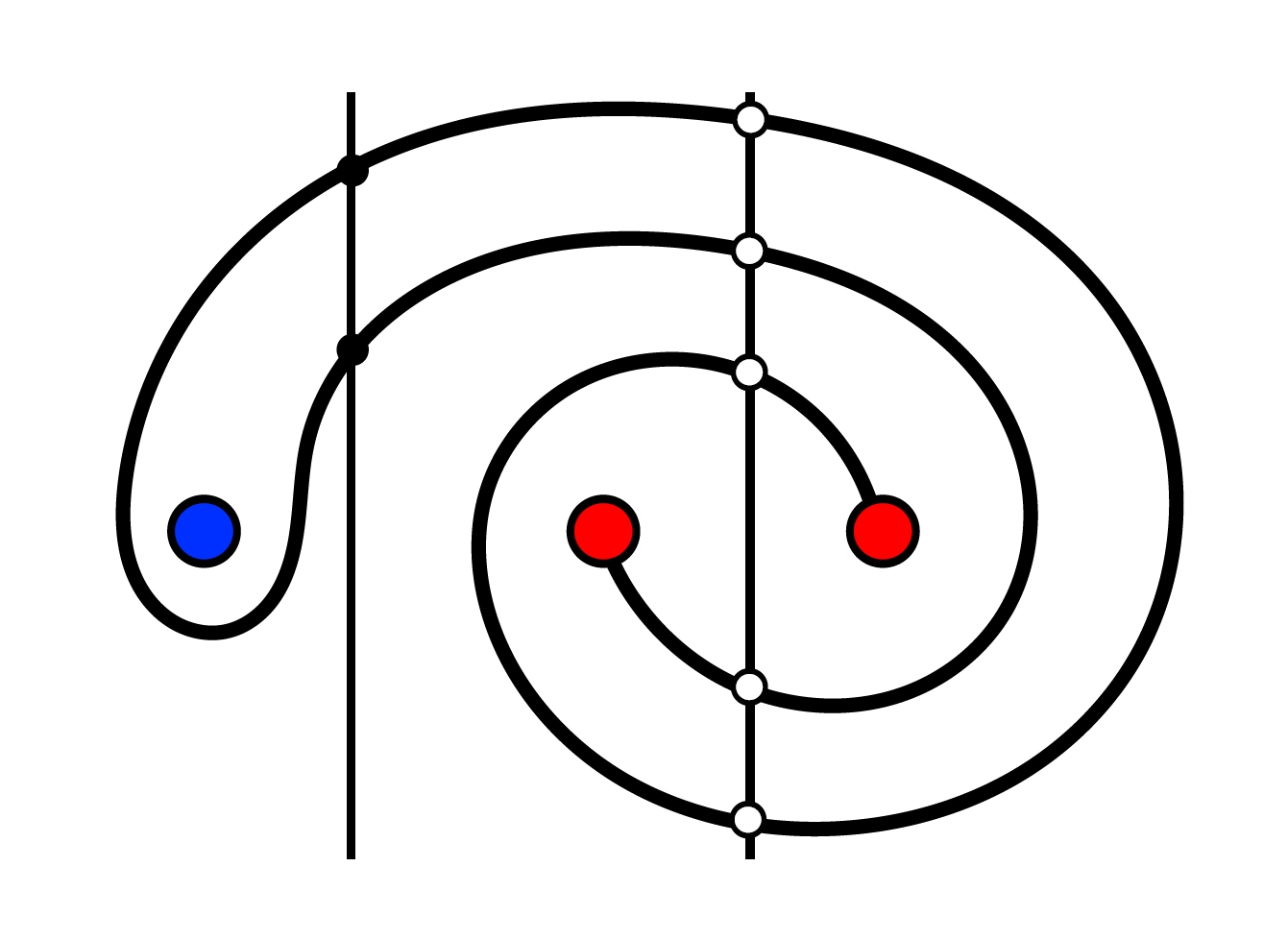
We use categorical skew Howe duality to find recursion rules that compute categorified sl(N) invariants of rational tangles colored by exterior powers of the standard representation. Further, we offer a geometric interpretation of these rules which suggests a connection to Floer theory. Along the way we make progress towards two conjectures about the colored HOMFLY homology of rational links and discuss consequences for the corresponding decategorified invariants.
Algebraic & Geometric Topology 16-1 (2016), 427-482
I'm a Fellow of the Higher Education Academy. I was selected as “Hochschullehrperson des Sommersemesters” (Lecturer of the semester) by the Fachschaftsrat Mathematik at Universität Hamburg in 2022 and 2026.
I am happy to list Bachelor and Master theses here if students explicitly ask me to. For the total numbers of theses supervised, please see my CV.